



South Luzon Expressway (SLEX) TR4 is the 66.74-kilometer extension of the South Luzon Expressway that will connect Sto. Tomas, Batangas to Lucena City, Quezon. Among the ongoing infrastructure projects south of Metro Manila, it makes some of the most specific promises: a four-hour drive reduced to one hour, and about 17,000 motorists expected to benefit every day. The Department of Transportation (DOTr) confirmed in July that the first three packages are set to open by December 2026. Construction has already started, and the full toll road is targeted for completion in June 2029.

What the SLEX TR4 extension project covers
The SLEX TR4 extension project adds a four-lane toll road to the existing SLEX toll road system, which currently ends at Sto. Tomas in Batangas. From there the new road runs through Laguna and into Quezon, ending at Barangay Mayao in Lucena City. The project is also known as Toll Road 4 (TR4), and the route spans 66.74 kilometers in total.
The endpoints matter. Sto. Tomas sits in an industrial and residential belt of northern Batangas, while Lucena City is the commercial center of Quezon and the usual gateway for travelers heading to Bicol. Between them, San Pablo City in Laguna and the Quezon towns of Tiaong, Candelaria, and Tayabas form a corridor that has depended on a single national road for decades.
The estimated cost is PHP58.4 billion, a figure excluding Package F, the final segment. SMC SLEX, Inc., formerly South Luzon Tollways Corporation oversees the project, and the Department of Public Works and Highways (DPWH) tracks construction progress. The groundbreaking took place in 2019, after delays that had spanned the terms of six presidents.
How the six packages are divided
The expressway is divided into six packages, which lets segments be built and opened in phases. Each package ends at a planned interchange, so a section can begin serving motorists as soon as its own construction is complete, without waiting for the full 66.74 kilometers to be built.
- Package A: Sto. Tomas, Batangas to Makban, Laguna (11.32 km)
- Package B: Makban to San Pablo City, Laguna (12.75 km)
- Package C: San Pablo City to Tiaong, Quezon (7.5 km)
- Package D: Tiaong to Candelaria, Quezon (15 km)
- Package E: Candelaria to Tayabas, Quezon (10.21 km)
- Package F: Tayabas to Mayao, Lucena City (9.96 km)
Seven strategic interchanges will let motorists enter and leave the toll road at Sto. Tomas, Makban, San Pablo City, Tiaong, Candelaria, Tayabas, and Lucena City. These exits carry as much weight as the total length. A town with an interchange gets direct expressway access, while a town without one still depends on the national road to reach it.
Construction status and the December 2026 target
DPWH data as of January 2026 showed three of the six packages targeted for completion within the year. Package B, from Makban to San Pablo, was 76.9 percent complete at that point, while Package A stood at 42.6 percent. In a televised interview in July, the DOTr confirmed through Transportation Secretary Giovanni Lopez that the target is to start operations in November or December, covering Packages A, B, and C. Together they cover about 31.6 kilometers from Sto. Tomas to Tiaong, nearly half of the route.
The remaining three packages are expected to follow in phases, with outlets reporting a June 2029 target for the completed expressway. Dates on a project this size work as targets. The 2019 groundbreaking came with a four-year implementation window, and the current timeline runs longer, which is a fair reason to follow official news updates from the DOTr and DPWH before building plans around an opening date, particularly for anyone arranging a move, a delivery route, or a daily commute.
Travel time from Sto. Tomas to Lucena: four hours down to one
On a bad day, the drive between Sto. Tomas and Lucena City can take about four hours along Daang Maharlika. Once the full expressway opens, the same trip is expected to take one hour.
The first phase delivers a smaller but earlier gain. Once Packages A to C open, travel time from Sto. Tomas to Tiaong will be 30 minutes, down from roughly two hours. With the whole road completed, travel time from Batangas to Lucena will be reduced to one hour. To reduce travel time at that scale, the project relies on a continuous toll road with no town centers, traffic lights, or tricycle lanes along the way.
For Manila-based motorists, the extension means the expressway no longer ends at Sto. Tomas. A trip toward Quezon and Bicol can stay on a toll road for far longer. The DPWH has also proposed Toll Road 5, a roughly 420-kilometer extension from Lucena City to Matnog, Sorsogon, which would carry the same road toward the Bicol Region.
An alternative route to the congested Maharlika Highway
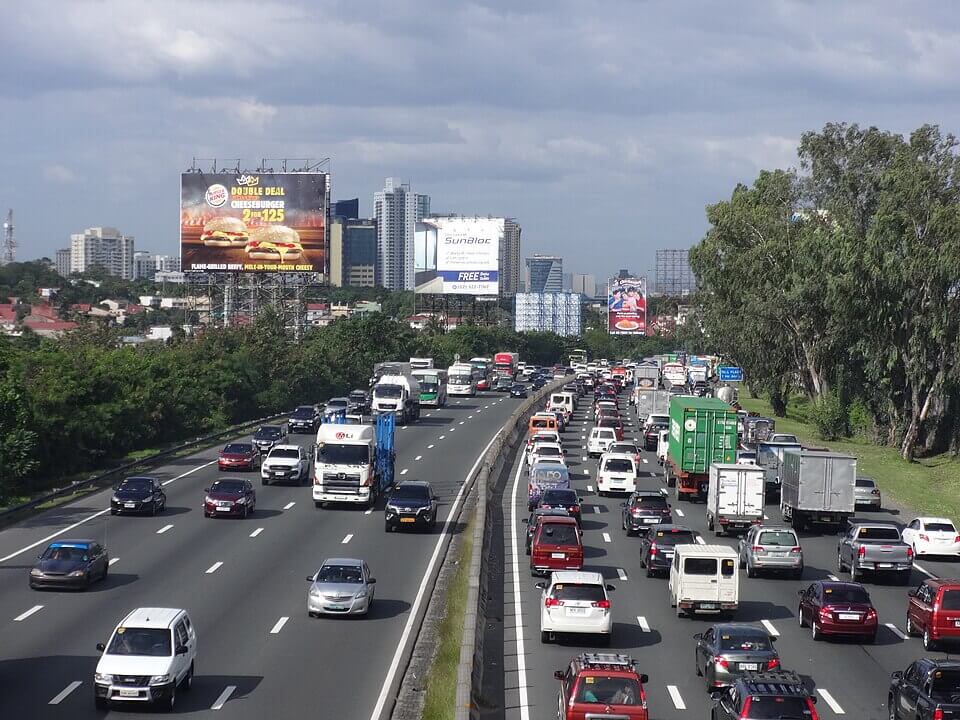
Daang Maharlika, the national highway that carries most of this traffic today, passes through town centers across Laguna and Quezon. Trucks, buses, tricycles, and private cars share the same lanes, and a 66-kilometer trip can stretch into several hours when traffic builds up. Holiday periods such as Undas and Holy Week, and festival weekends like the Pahiyas in Lucban, make the road slower still.
SLEX TR4 aims to provide an alternative route for long-distance transport. About 17,000 motorists are expected to benefit from it daily. If a large share of through traffic moves to the toll road, local roads should carry fewer vehicles that are only passing through, which would also ease conditions for residents who use the old route for short trips, school runs, and errands.
Goods, logistics costs, and the provinces along the route
Faster road transportation is also a freight story. The expressway is expected to improve the efficient transport of goods and, in turn, reduce logistics costs. Farm produce, coconut products, poultry, and manufactured goods from Quezon, Laguna, and Batangas all move through the same corridor, and a shorter trip means fewer hours per truck and fresher cargo at the market.
This new development is expected to bring new businesses growth to small towns and barangays along the route. Shorter travel times also bring hospitals, universities, and government offices in cities like San Pablo and Lucena within easier reach of neighboring towns, which matters for people who now plan their days around a long drive for basic public services.
What SLEX TR4 means for homebuyers in Laguna, Batangas, and Quezon
For buyers, the practical question is how far a property sits from an interchange and what the daily route to work looks like. Families who work in Metro Manila, Calamba, or Batangas City and want more space may start to consider towns such as San Pablo, Tiaong, or Candelaria, which sit directly on the corridor.
Expressway access has historically raised interest in towns near interchanges, though the effect on prices varies by location and timing. Details that remain to be confirmed closer to opening, such as toll rates and exit points, deserve a place on any buyer’s checklist. Commuters should also test the route at peak hours, before and after each package opens, since a faster highway can still back up at its interchanges. Anyone weighing a purchase in the provinces covered by SLEX TR4 should compare current commute times with the projected ones, and treat the December 2026 and June 2029 dates as the schedule to watch.
A faster road south, and the places it brings closer
SLEX TR4 will extend the South Luzon Expressway by 66.74 kilometers across six packages, with the first three set to open by the end of this year and the rest following until the June 2029 completion target. The numbers are clear enough to plan around: four hours reduced to one, 30 minutes from Sto. Tomas to Tiaong, and a toll road built to meet the needs of a growing southern corridor.
For the people of Batangas, Laguna, and Quezon, the project changes how far everyday destinations feel, from the workplace to the hospital to the family home. The extent of that change will depend on how soon each package opens.
Explore Camella’s house and lot communities in Southern Luzon and find a home that suits your daily routine as SLEX TR4 brings Batangas, Laguna, and Quezon closer to Metro Manila. Read more about these Camella communities. Check out social media page, contact, or visit Marketing Offices nearest you.